
Art Guides
Types of Artwork: 22 Art Types Australian Artists Work In
Aima Eman · · 11 min read
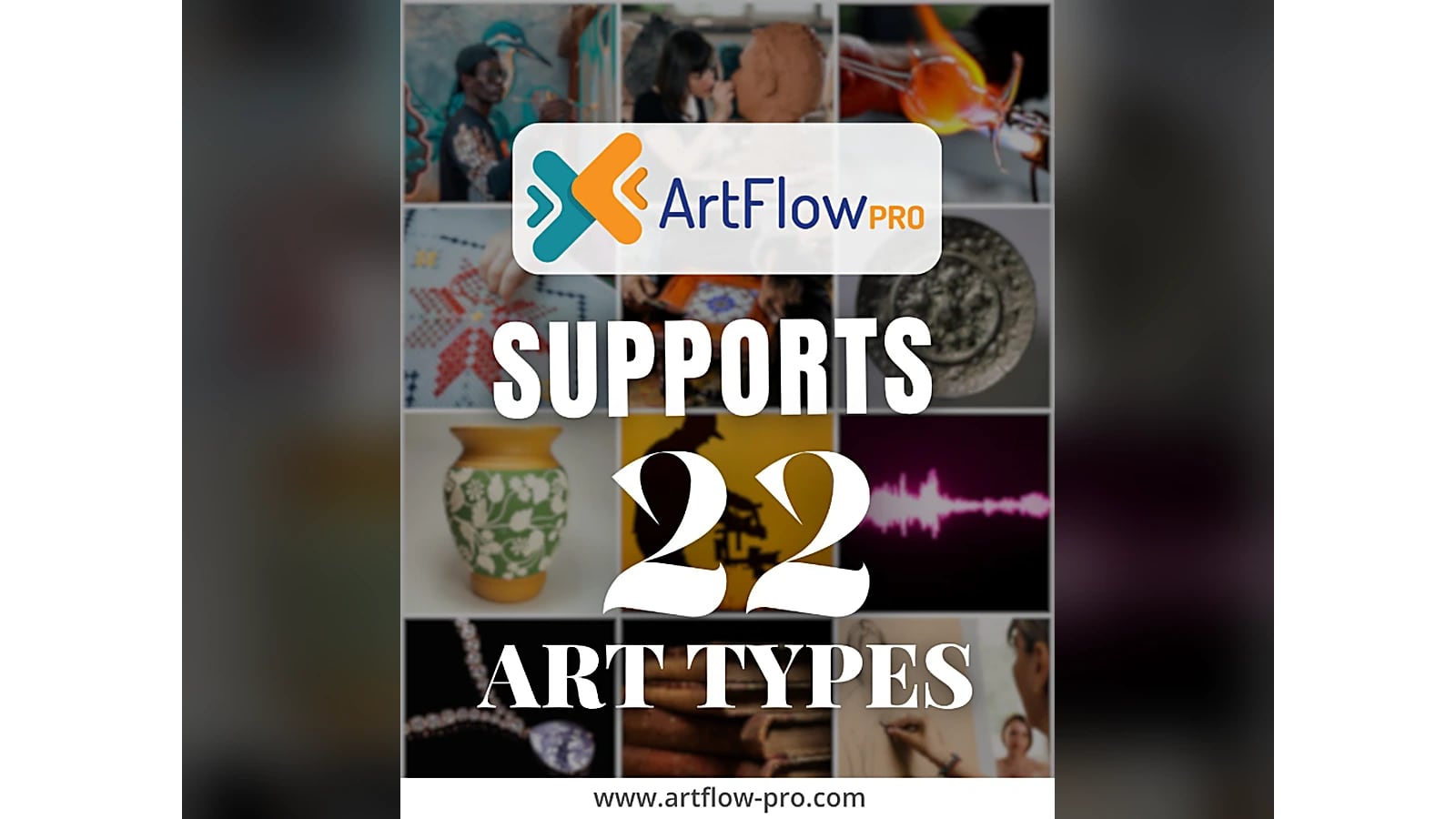
Ask an artist which types of artwork they make and you'll often get a long pause. A potter who also paints doesn't want to pick one. Neither does the printmaker who's started stitching her prints into quilts. But once a gallery or a buyer gets involved, the work has to sit under a heading, and that heading quietly decides what people ask you next.
The short answer: ArtFlow supports 22 types of artwork, and they fall into four groups. On the wall: painting, drawing, printmaking, photography, illustration, digital art, mixed media, and street art and murals. Standing up: ceramics, sculpture, glass, woodwork, metalwork, and mosaic and tile. Worn or used: jewellery, textiles and leatherwork. In a space or over time: installation, performance, sound art, light art and video art. Each one comes with its own starting materials and techniques when you catalogue it, so you're never filling in a blank form.
Why the types of artwork matter when you sell
A painting and a glass bowl might end up in the same lounge room. Getting them there is a completely different job.
The painting needs to say whether it's framed. The bowl needs a weight, because the courier will want one before quoting. A print needs an edition number, or nobody serious will touch it. Get these details down once, properly, and you stop answering the same email every time someone's keen.
Quick reference: what buyers ask first
Wall work: size, framing, and whether it's an original or one of an edition
Standing work: weight, indoor or outdoor, and how it's packed
Worn or used: materials, sizing, and how to look after it
Space and time work: what the buyer actually receives, and what it needs to be shown
Types of artwork that hang on a wall
1. Painting
Oil, acrylic, watercolour, gouache. People want the size first and the price second, and they always want to know if it's framed. Say what it's on (canvas, board, paper) and give both measurements if the frame adds much. Painted edges on an unframed canvas are worth a mention too, because a lot of galleries will hang those without a frame at all. Have a look at how other painters list theirs on the painting page.
2. Drawing
Charcoal, graphite, pastel and ink, nearly always on paper. Pastel smudges if you look at it wrong, so say whether it's been fixed and whether it's under glass. If it was a study for a bigger piece, tell people. Collectors love that. Browse the drawing to see how it's done.
3. Printmaking
Of all the types of artwork, this is the one where paperwork matters most. Etching, linocut, screenprint, lithograph, woodcut: whatever the technique, a buyer who knows prints wants the edition size, which number this one is (say 4/20), whether it's an artist's proof, and the paper. Usually before they'll even ask the price. The Blue Mountains alone has a good few printmakers, and work as theirs belongs on the printmaking page.
4. Photography
Nearly always sold in editions. Name the print process (archival pigment, silver gelatin, C-type) and the size, because the same image can come in three sizes with three separate editions. More on the photography page.
5. Illustration
Is it the original or a print? That's the first question, every time. If it was drawn for a picture book or a magazine, say which one. Keep originals and prints as separate records so nobody pays for one expecting the other. See illustration.
6. Digital art
Here the confusion is nearly always about what the buyer actually gets. A print? A file? Both? A licence to use it? Spell it out. If there's a physical print, give its size and material. There's a separate digital art page for this work.
7. Mixed media
Collage, assemblage, paint over print, found objects glued to board. List everything that's in it, since the materials decide how it's hung and cleaned. And give the depth. People forget depth, then find out their shelf is too shallow. See mixed media.
8. Street art and murals
You can't post a laneway wall to anyone, so what you're really cataloguing is the commission. Hosier Lane in Melbourne and the painted grain silos out in regional Victoria have made Australians very used to big outdoor work. Record the location, the wall size, the date, who commissioned it and the paints used. Keep the sketches and smaller canvases as their own records, since those are what most buyers can actually take home.
Types of artwork that stand up
9. Ceramics
Stoneware, porcelain, earthenware, raku. The questions are nearly always practical: can I eat off it, does it go in the dishwasher, is it food safe? Give the clay, the glaze and the firing. If there's gold lustre, say so loudly, because lustre and dishwashers don't mix. We've covered the rest in how to care for handmade ceramics, and there's plenty to look through on the ceramics page.
10. Sculpture
Sculpture gets priced and freighted on size and weight, so be exact about both. Is it for inside or out? Anyone who's walked Sculpture by the Sea at Bondi or Cottesloe knows salt air and sun don't treat every material the same. Say whether it needs a plinth, and whether it's a one-off or cast in an edition. It's listed on the sculpture page.
11. Glass
Blown, lampworked, kiln-formed, cast, stained. Couriers get nervous about glass, and fair enough, so give the weight, the size, and how you pack it. Buyers mostly ask about light, because a glass piece looks completely different on a sunny sill than in a dim hallway. Australia has a strong glass scene, from Canberra Glassworks to the JamFactory in Adelaide, and the glass page is where makers list their work.
12. Woodwork
Buyers care about the timber. Huon pine, jarrah, blackwood, something pulled out of an old woolshed: name it. Mention the finish and how to look after it, since wood moves with the weather and a Queensland summer is nothing like a Hobart one. More on the woodwork page.
13. Metalwork
Forged, cast, fabricated or hammered into relief. The finish is the thing. Some patinas are meant to change outdoors, and some buyers want exactly that, while others will be upset when it happens. Say which it is. Weight matters here as well. See metalwork.
14. Mosaic and tile
Hand-painted tiles, glass mosaic, broken-crockery pieces set into a garden wall. The big questions are weight and whether it's meant for indoors or out. A splashback panel and a courtyard piece need different grout and different care, so say which yours is, and give the total weight, because tile adds up fast.
Types of artwork you wear or use
15. Jewellery
Tiny pieces, lots of detail. Metal and purity, the stones, ring size or chain length, and whether it's one of a kind or part of a small run. People will ask if you can resize it, so answer that before they have to. Browse jewellery by maker.
16. Textiles
Weaving, quilting, cross-stitch, embroidery, felt, natural dyes. Give the fibres, how it hangs and how to clean it. Australian sun through a west-facing window will fade most dyes faster than people expect, so a line on where to hang it saves a lot of disappointment later. See the textiles page.
17. Leatherwork
Bags, belts, tooled panels, bound journals. There's a long saddlery tradition in the Australian bush, and buyers who know leather ask straight away about the hide and the tanning. Vegetable-tanned or chrome? Hand stitched or machine? Say so, and add a care line, because leather dries out in our heat if it's never fed.
Types of artwork that happen in a space or over time
Some types of artwork don't sit on a shelf at all.
18. Installation
Built for a room, and often rebuilt for the next one. What you're handing over is as much the instructions as the objects: every component, the space it needs, how long setup takes, and any power or lighting it relies on.
19. Performance
It happens once and what survives is the record. Video, photos, props, a signed certificate. Be clear what a buyer or an institution is actually getting, whether that's documentation or the right to restage it.
20. Sound art
Shown through speakers, headphones, or a purpose-built room. Give the running time, how many channels, the playback it needs, and the edition. Like digital work, be plain about what the buyer walks away with.
21. Light art
Neon, LED, projection, work built around a lamp or a window. Vivid Sydney has turned a lot of people onto it. The record needs the power supply, the bulbs or tubes and where to replace them, the running hours, and whether it's safe outdoors. Nobody wants to find out the transformer is obsolete after they've bought it.
22. Video art
Single screen or multi-channel, looped or with a start and finish. Give the running time, the format, the screens or projectors it needs and the edition. As with sound, say whether the buyer gets a file, a media player, or both, and who fixes it when the file won't play in ten years.
When a piece fits two types of artwork
A ceramic lamp. A printed textile. A carved timber box with a glass lid. Plenty of work sits in two places at once, and that's fine. File it under the type a buyer would search for first, then mention the rest in the description. A series name can tie related pieces together, whatever they're made of.
Buying close to home
Across all types of artwork, a lot of people would rather buy from someone down the road, and most galleries would rather not freight a large piece across the Nullarbor. So work on ArtFlow can be browsed by state and town as well as by medium. If you're in New South Wales, start with artists in NSW.
What every piece needs, whatever it is
Title. Year. Size. Weight. Price. Where it physically is right now, which sounds obvious until something's been at a gallery in Byron for eight months and nobody's quite sure. Add a series if it has one, and a description written for a person rather than a search engine.
Then photos. Good ones sell more work than any description does. The ArtFlow features include background removal and a first-draft description, so a piece shot on a cluttered studio bench can still look clean on its page.
Tip: If you consign to galleries, read the NAVA Code of Practice once. It's the standard reference in Australia for what an artist and a gallery should agree on, and nearly all of it assumes your pieces are properly described to begin with.
Questions people ask about types of artwork
How many types of artwork does ArtFlow support? 22. Painting, drawing, printmaking, photography, illustration, digital art, mixed media, street art and murals, ceramics, sculpture, glass, woodwork, metalwork, mosaic and tile, jewellery, textiles, leatherwork, installation, performance, sound art, light art and video art. Each has its own default materials and techniques.
Is a medium the same as a type of artwork? Close enough for most buyers. Strictly, the medium is the material (oil paint, stoneware, silver) and the type is the kind of work (painting, ceramics, jewellery). A listing needs both.
Which types of artwork are hardest to send to a gallery? Glass, ceramics, mosaic and large sculpture, because of weight and breakage. Give an exact weight and packing notes in the record, and the gallery and courier can plan properly.
How do you sell work you can't pick up, like a mural or a performance? You sell the commission, the documentation, or the smaller pieces around it: sketches, prints, photographs, a signed certificate. Catalogue each of those as its own record.
Can one piece count as two types of artwork? Yes. List it under the type buyers are most likely to search for, and mention the other in the description.
The short version
There's no wrong type of artwork, only work that's badly written up. Wall pieces need framing and edition details. Standing pieces need weight and care notes. Wearables need sizing and materials. Work that lives in a space or on a screen needs instructions. Answer those questions in the record once, and every page, gallery, and buyer gets the same answer. You can browse the artworks already listed around Australia, or start a free account and catalogue your first piece tonight.