
Market Stall Tips for Artists and Makers: An Aussie Checklist
Thinking about a market stall this summer? Here's what Australian artists and makers need to know first: choosing the right market, insurance, pricing and display, card payments after the October 2026 surcharge ban, and a packing list for the big day.
Aima Eman · · 10 min read
Your first market stall feels a bit like opening night, and a dentist appointment rolled into one. Weeks of making. A car packed so tight you can't see out the back window. Then it's 5.40 am in a dark car park in Rozelle, and you're wrestling a gazebo you've put up exactly once, in the backyard, with your brother holding the other leg. Cold hands. Lukewarm coffee. Doubts.
And then the sun comes up. The coffee van starts hissing. People drift past, slow down, and someone picks up a thing you made and says, "Oh, I love this." Just like that, the 4 am alarm makes sense.
We reckon a market stall is still one of the best ways for Australian artists and makers to sell. You meet buyers face to face, you keep the full price, and you learn in one morning what months of Instagram posts never tell you. But good market days don't just happen. Here's what we'd want to know before booking that first site.
Key takeaways
Pick a market whose crowd suits your work and price point. Busiest isn't always best.
Most organisers want public liability insurance, often with a minimum cover amount. Sort it before you apply.
Price everything clearly, with one total price that includes any GST.
From 1 October 2026, you can't add a surcharge for Visa, Mastercard, American Express or EFTPOS card payments.
Pack for wind, heat and rain. The weather doesn't care that it's your big day.
Picking the right market for your stall
Here's something nobody tells you. The biggest market in town might be the worst one for you. A packed Saturday farmers' market can pull thousands of people, but most of them came for sourdough, eggs and a bunch of kale, not a A$300 vase. A smaller curated makers' market might be half as busy, yet far more of those shoppers turned up to buy handmade.
So go as a shopper first. Walk the whole thing, slowly. Who's actually buying? What are they carrying back to the car? What are things priced at? Are there already four stalls selling something a lot like yours? Have a chat to a stallholder when it's quiet. Most will happily tell you how the day's going, and whether it's worth it.
Curated markets can be fussy about who gets in, and that's not a bad thing. Northern Beaches Council's Creative Made market, for example, won't take items that weren't handmade by the maker themselves, like work designed here but produced overseas or in bulk. If you make everything yourself, rules like that are on your side.
Fees, insurance and the paperwork
Site fees are all over the place. Every market sets its own, and big city markets and Christmas pop-ups usually charge more than a little community fair. To give you one real example, a site at Creative Made was A$60 including GST, with bump-in done by 9.45am and everyone gone by 4 pm. Read the stallholder info properly. Twice.
Then there's insurance, the bit everyone forgets until the market stall application asks for it. Most organisers want stallholders to carry their own public liability insurance, and some set a minimum. Creative Made asks for at least A$20 million of cover, plus a certificate of currency with your application. A few markets offer cover under their own policy, but check what's actually included before you rely on it.
Selling every other weekend? That starts to look like a business, which brings ABNs and GST into it. We've already covered the hobby or business question in our guide on how to sell pottery, and it applies whatever you make.
Pricing your stock for a market
The golden rule for any market stall: your price at the market is your price everywhere. Same as the gallery, the shop down the road and your website. Undercut your stockists on a Sunday, and you'll likely lose them by Monday.
So get your prices right first. Cover materials, your time and the cost of selling, then check they'd still work if a shop ever bought from you wholesale. Our guide on how to price your artwork walks through the maths without the headache.
Then look at your range. A table that sells usually has a bit of everything. Little impulse buys, like cards, prints, tiny dishes or brooches. Mid-range pieces, which tend to do most of the work. And one or two show-stoppers that make people stop mid-step, even if they don't sell every time. Funny how it works. The big piece pulls them in. The A$25 one is what goes home in the tote bag.
Price tags and card payments
Price everything on your market stall. Everything. Plenty of people won't ask. They'll just smile, put it down and wander off. Tags, little signs or a neat price list all work, as long as people can read them from a step back.
The ACCC says businesses have to show a total price that includes taxes and any unavoidable fees. If an item ends up with two different prices on it, you have to sell it at the lower one or stop selling it until it's fixed. So when you change a price, rip the old tag off.
Cards are non-negotiable now. Loads of shoppers don't carry a single dollar coin. And this season brings a big change. According to the ACCC, from 1 October 2026 businesses can't charge a surcharge on payments made with Visa, Mastercard, American Express or EFTPOS credit, debit or prepaid cards. If you used to add a percentage for card payments, build the fee into your prices instead. The ACCC's page on card surcharges has the details. Charge the reader the night before, test it at home, and have a plan B for when the signal drops out at a country showground, because sooner or later it will.
Tip: Price your tags the night before, at the kitchen table, not on the day. Morning-of pricing always runs late, and that first half-hour, when the keen early birds come through, is often your busiest of the day.
Setting up a market stall that sells
Everything laid flat on a trestle table looks like a garage sale. Give it some height. Crates, little shelves, plinths, even sturdy boxes covered with fabric. You want the eye to travel up and across. Put your best pieces at eye level near the front corner, because that's what people see as they wander past.
Less is more, too. A few pieces shown well beat a crammed table every time, and you can restock as things go. A tablecloth that reaches the ground hides the boxes underneath and makes the whole stall look finished. Add a clear sign with your name on it, so people can find you again next month, or online tonight.
Then stand up, smile and say g'day. Don't pounce. "Let me know if you've got any questions" is plenty. When someone asks, tell them the story: what it's made of, how you made it, where your studio is. That story sells more handmade work than any discount.
Working in fabric? Our round-up of textile art in Australia has fairs and prizes worth knowing about too.
What to pack
Here's the list we wish someone had handed us before our first market stall:
Gazebo and weights. Proper weights on every leg. One gust and an unweighted gazebo goes cartwheeling across the car park.
Table, chair and a tablecloth.
Display bits. Crates, stands, easels, little shelves.
Stock, plus extra. Packed so restocking is quick.
Card reader, charger and a power bank. Plus a small cash float.
Price tags, pens, tape, scissors and string.
Bags, tissue paper and padding. Lots of padding for anything breakable.
Business cards or a QR code that links to your website or online shop.
Water, snacks, sunscreen, a hat and a jumper. Freezing at 6 am, baking by noon. Classic.
Your insurance certificate. Some organisers check on the day.
Christmas markets are a different beast
From late November, Christmas markets pop up in just about every suburb and country town. They're busy, shoppers are in a giving mood, and a good day can be a really good day. The catch? Sites book out early, so get your applications in now.
Think like a gift buyer. Have a few pieces at friendly prices, offer to wrap, and be ready for "do you think my sister would like this?" Our guide to buying art as a gift shows what buyers are thinking this time of year, which helps when you're planning stock.
After the market
Pack up the market stall, drive home, collapse on the couch. You've earned it. But the next morning, while it's fresh, jot down what sold, what didn't, and what people kept asking about. Which piece did everyone pick up and put down? Which price point flew? Did one colour sell out by ten? A few notes after each market beat a year of guessing.
Follow up with anyone who asked about custom work, and send people to your website for things you didn't bring. Make sure the photos there do your work justice. Our older guide to photographing your art covers the basics with just a phone, and our older post on why every artist needs a website explains why it matters more than social media alone.
Keep track of your stock.
Markets get messy fast once you're also selling online, through a shop or on consignment. Which mugs came home from the weekend? Which are still at the gallery? What actually sold on Saturday?
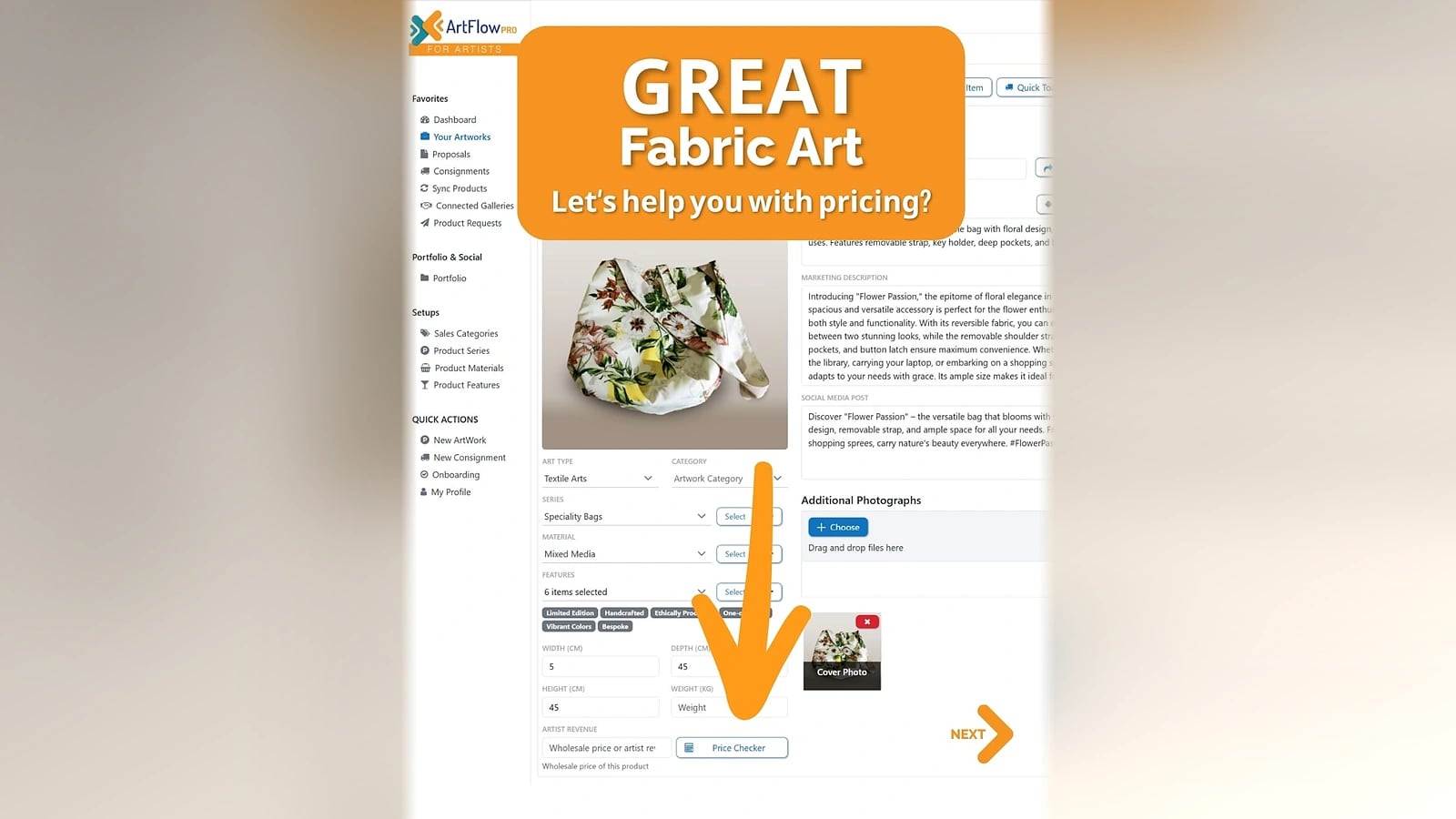
In ArtFlow, each piece keeps its photos, price and history in one place, so you know what's available before you load the car. The Price Checker, which you can see on the cover of this post, helps you set a retail price that still pays you properly once commission and tax come out. The features page has the full rundown.
Questions about running a market stall
How much does a market stall cost in Australia? It depends on the market. Every organiser sets their own fee, and big city and Christmas markets usually cost more than small community ones. Check the stallholder info before you apply.
Do I need insurance for a market stall? Usually, yes. Most organisers ask for public liability insurance, often with a minimum cover amount such as A$20 million. Some offer cover through their own policy.
Can I add a surcharge for card payments? Not for Visa, Mastercard, American Express or eftpos cards. The ACCC says those surcharges are banned from 1 October 2026.
What sells best at art markets? A mix tends to work: cheap impulse buys, mid-range pieces and a couple of standout works. Watch what moves and adjust next time.
How do I make my stall stand out? Add height, keep it tidy, price everything clearly and put your name up where people can see it.
The short version
A good market stall comes down to picking the right market, sorting insurance early, and pricing everything clearly with one total price. Card surcharges on the big networks are out from October 2026, so build that into your prices. Give your display some height, pack for four seasons in one day and take notes after every market. And if you'd like one easy place to track your stock across markets, shops, and online, start a free ArtFlow account before your next market day.