
Art Guides
Grants for Artists in Australia: Where to Look and How to Apply
Federal, state, regional, and private grants for artists in Australia, with real amounts, real success rates, and the next rounds worth planning for. Plus what assessors actually look at when they open your application.
Aima Eman · · 9 min read
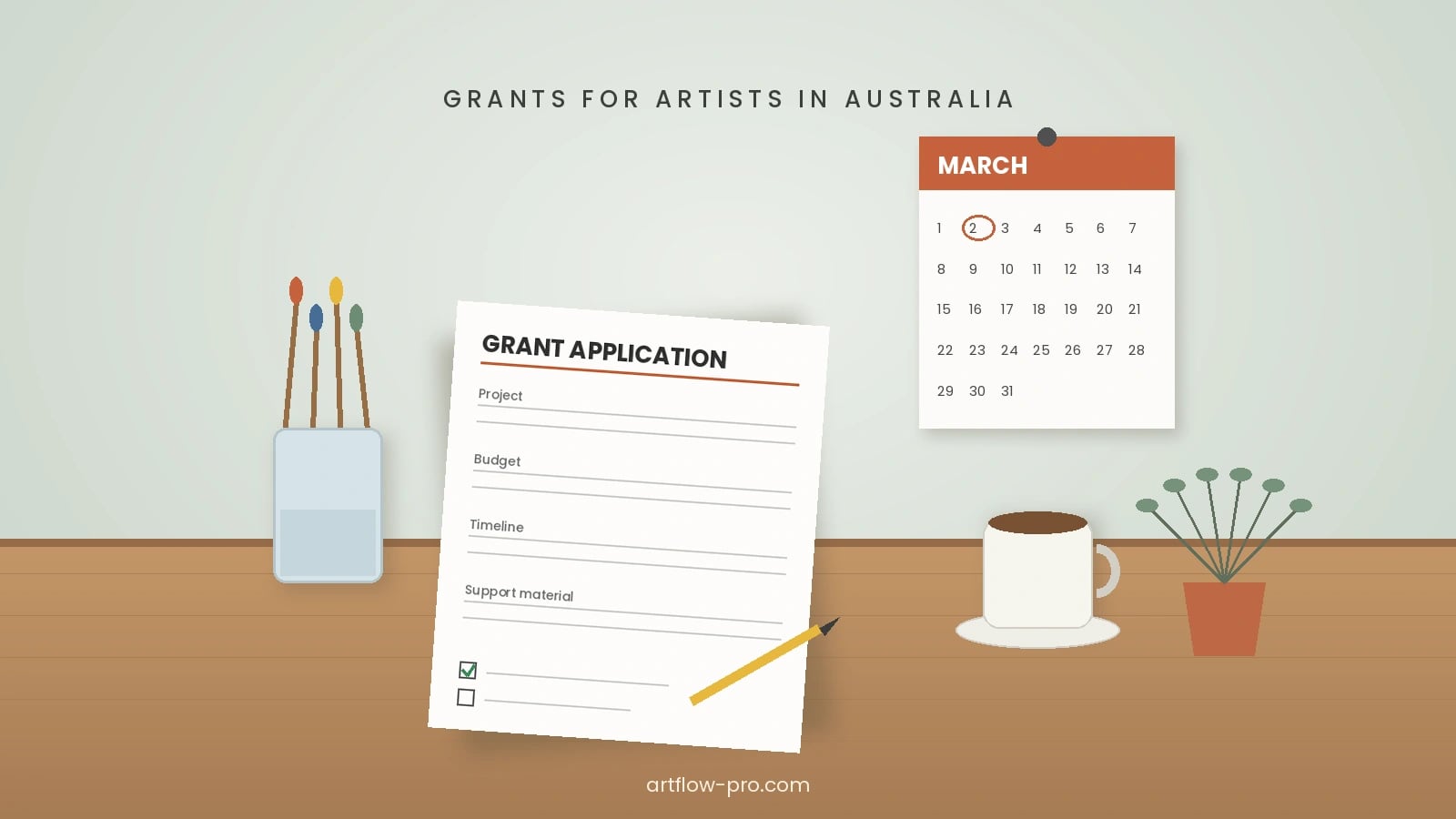
Grants for artists in Australia are real money. For plenty of working artists, they're what turns a project from a page in the sketchbook into an actual show, residency, or body of work. They're also slow and competitive, and the forms seem built to make you quit somewhere around the budget table. So a lot of good artists never apply. Or they apply once, get a polite no, and decide it isn't for them.
That's a shame, because the system around grants for artists is less mysterious than it looks. Here's where the money comes from, how much is on the table, what your odds really are, and how to write something an assessor can say yes to.
Key takeaways
Creative Australia's Arts Projects for Individuals and Groups offers A$10,000 to A$50,000. Around 10 to 15% of applications succeed. The next round closes on 2 March 2027.
State arts bodies, the Regional Arts Fund, private trusts and local councils all fund artists too, and some are far less crowded.
The Ian Potter Cultural Trust's Emerging Artist Grants go up to A$15,000, roughly 20 to 30% of applicants succeed, and the next round opens on 24 November 2026.
Assessors judge what they can see. Clear writing, a realistic budget, and strong images beat big claims.
If you work as a professional artist, grant money is generally assessable income, so plan for tax.
Where grants for artists actually come from
Think of the funding as layers. Each one has its own size, odds, and paperwork, and nobody says you have to start at the top.
Federal: Creative Australia
If you're after the big one, it's Creative Australia's Arts Projects for Individuals and Groups. Grants run from A$10,000 to A$50,000 and can cover nearly anything that moves your practice along: new work, exhibitions, residencies, mentoring, touring. A project can run for up to two years.
The fine print? You need to be an Australian citizen or permanent resident and a practising artist or arts professional, and you only get one application per round. The September 2026 round has closed, and results are due in early December. The next one closes at 3 pm on 2 March 2027. Register in their online system early, because sign-up alone can take up to two business days, and nobody wants to find that out the Sunday before the deadline.
Creative Australia is refreshingly honest about the odds. Around 10 to 15% of applications get funded. Don't let that scare you off. Let it push you to write a sharp application, and to apply somewhere else at the same time.
State and territory arts bodies
Every state and territory runs its own grants for artists, and for a lot of people they're a smarter first shot than the national round. Create NSW's Creative Steps, for one, offered A$10,000 to A$75,000 for new work in 2026, open to artists who'd lived in NSW for at least a year. Victoria, Queensland, SA, WA, Tassie, the ACT and the NT all run their own programs, each with its own dates and quirks. Get on your state arts body's mailing list so the next round doesn't sneak past you.
Regional Arts Fund
Live outside the capitals? Good news. The Regional Arts Fund is an Australian Government program worth about A$6 million a year, managed by Regional Arts Australia and handed out through regional arts organisations in each state. Project grants go up to A$30,000, and quick response grants cover smaller things that pop up at short notice. You'll need to be based in a regional or remote area. The 2027 project round opened in July 2026.
Private trusts and foundations
Some of the most useful money isn't government money at all. The Ian Potter Cultural Trust gives Emerging Artist Grants of up to A$15,000, mostly for professional development overseas, to artists within about ten years of their first formal arts qualification. The Trust puts its success rate at roughly 20 to 30%, which beats the national odds comfortably. Copyright Agency's Cultural Fund also offers Create Grants of A$20,000 to visual artists and authors working on significant new work, and it funded five of them in 2026.
Local councils
Then there's your own council. Plenty of them offer small grants for artists, like City of Sydney's artist support grants, usually for local projects and smaller sums. A council grant is a handy way to get that first line on your CV while you learn how applications work.
How to apply for grants for artists
Assessors are often fellow artists and arts workers (Creative Australia calls them peer assessors), and they get through a lot of applications in not much time. Picture someone on their thirtieth form of the day with a cold cuppa next to the keyboard. Be kind to that person.
Get to the point early. In your first paragraph, tell them what you're going to make or do, why now, and how you'll pull it off. Creative Australia's advice is to write in your own voice, clearly and without jargon, which is good advice for nearly everything. Find it hard to write about your own work? Our guide on how to describe your artwork helps just as much with grant writing as it does with wall labels.
Make the numbers add up. The budget is where a project looks either real or wishful. At Creative Australia, you ask for your total cash costs minus any cash income; admin costs should usually stay under 10% of the budget, and artist fees (yours included) should be at industry rates. So pay yourself. If you're not sure what your time is worth, how to price your artwork walks you through it.
Show the plan. A month-by-month timeline tells an assessor you've thought it through. Who's doing what, when, and what happens if the foundry runs three weeks late.
Chase support letters early. A short letter from a gallery, venue, mentor or community group that's involved carries real weight. Ask weeks ahead. Everyone's flat out.
Tip: Assessors often look at your support material before they read a single word. Creative Australia caps it at about 10 images, 10 minutes of video, or 10 pages of writing, and links must open without a login, because assessors won't sign up to anything. Pick your strongest recent work, photograph it properly, and click every link yourself. Treat it like an artist portfolio built for one very picky audience.
Common reasons applications get knocked back
Funders rarely send a full list of reasons, but a few problems turn up over and over. The project's too fuzzy to picture. The budget doesn't match the plan, or the artist's own fee has quietly gone missing. The images are small, blurry, or five years old. The answer doesn't match the question. Or the project just isn't eligible, like asking a program that doesn't fund study to pay for a course.
None of that is a judgement on your art. When only 10 to 15% get through, plenty of strong projects miss out every round. Some funders will give feedback if you ask nicely. So ask, tweak it, and send it again next time.
Are grants for artists taxable?
Here's the bit people forget. NAVA's Code of Practice says grants and prizes count as assessable income for artists who are in business. So if A$20,000 lands in your account in June, right before EOFY, don't blow the lot on materials in July without a thought for tax time.
Whether you're treated as a professional or a hobbyist comes down to things like whether you're trying to make a profit, whether you exhibit, and whether you're eligible for grants. The ATO has a ruling on it. Find an accountant who knows artists. This is general information only, not tax advice.
Keeping track of the paperwork
Grants for artists come with admin at both ends. Before: your best images, correct titles, sizes and dates, and a CV that's actually current. After: usually a final report, often called an acquittal, showing what you made and where the money went. Some funders won't look at a new application while an old report is overdue, so don't let it slide.
It all goes faster if your work is already organised. In ArtFlow, every piece keeps its own photos, details and history, so pulling ten good images and their captions together for an application takes a few minutes, not a whole evening digging through folders called "final FINAL". For the bigger question of making your practice pay, our earlier post on the full-time artist is worth a read.
Questions about grants for artists
Where can artists get grants in Australia? Start with Creative Australia nationally, then your state or territory arts body. If you're outside the capitals, look at the Regional Arts Fund. Private trusts like the Ian Potter Cultural Trust and Copyright Agency's Cultural Fund are worth a look too, and so is your local council.
How much can an individual artist get? It varies a lot. Creative Australia's Arts Projects for Individuals and Groups range from A$10,000 to A$50,000, Regional Arts Fund project grants go up to A$30,000, and council grants are usually smaller.
What are the chances of getting a grant? Creative Australia says about 10 to 15% of applications to Arts Projects for Individuals and Groups are funded. The Ian Potter Cultural Trust reports roughly 20 to 30% for its Emerging Artist Grants.
Do I need an ABN to apply? For some programs, yes. Create NSW's Creative Steps and the Regional Arts Fund both ask for one. Check the guidelines before you start writing.
Are arts grants taxable in Australia? If you're an artist in business, grants are generally assessable income. Talk to an accountant about your own situation.
The short version
Grants for artists exist at every level, from a few thousand dollars at your local council to A$50,000 from Creative Australia. The big rounds are tough, so spread your bets, try the smaller and regional programs first, and put real effort into your budget and images. Use the summer break to get organised: the Ian Potter round opens in late November, and Creative Australia closes in early March. Want your images and details ready when the form opens? Start a free ArtFlow account and catalogue your best work now.