
How to price artwork in Australia: a practical guide with real numbers
A practical guide to how to price artwork in Australia: work out your cost floor, use a size or time formula, check the local market, and allow for gallery commission and GST.
· 8 min read
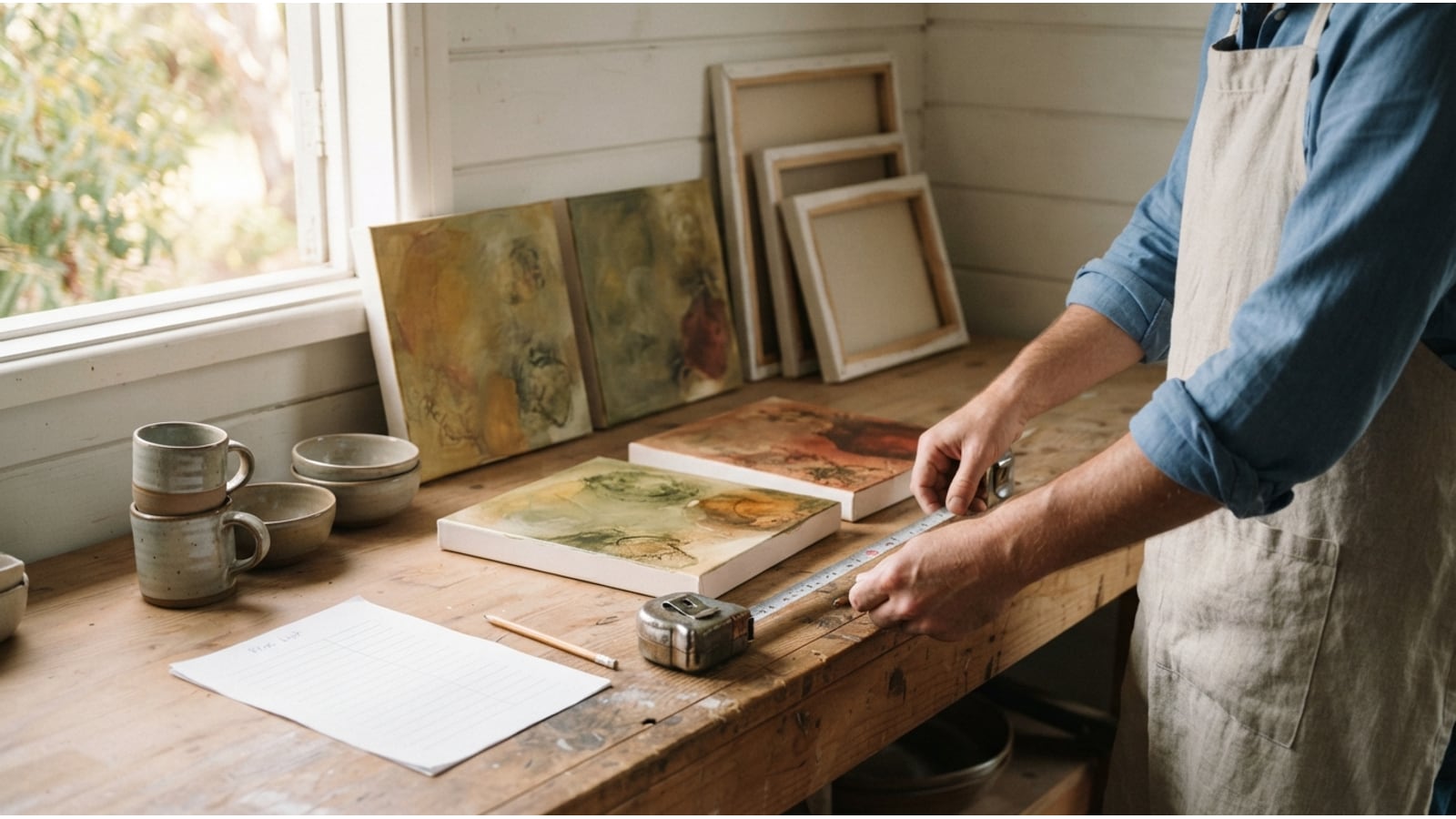
To price artwork, add up what each piece costs you to make, choose a simple formula (by size or by hours), then check the result against work by artists at a similar stage in your area. Set one retail price that stays the same in a gallery, at a market and on your website, and make sure it still pays you after commission and GST. That is how to price artwork in a way buyers trust and you can stick to.
Start with what each piece costs you
Before any formula, know your floor. This is the price below which you lose money on a sale.
List the direct costs for one piece:
- Materials: canvas or board, paint, clay, glaze, paper, ink.
- Framing or presentation: frame, mat, glass, D-rings and wire, a stand for a platter.
- Packaging: bubble wrap, corner protectors, a box.
- A share of overheads: studio rent, kiln power, website fees, insurance. Divide a month's overheads by the number of pieces you finish in a month.
Say a 40 x 50 cm acrylic on canvas costs you A$45 in canvas and paint, A$110 to frame and A$15 to pack. Your studio and other overheads come to A$400 a month and you finish 8 paintings a month, so each one carries A$50. Your floor is A$220 before you have paid yourself a cent.
Keep these numbers next to each piece in your catalogue. You will need them again when a gallery asks about margins or a buyer asks for a discount.
Pick a pricing method you can repeat
There is no single right answer to how to price artwork, but buyers notice when two similar works carry very different prices. A formula keeps you consistent. Three methods work well, and you can combine them.
Price by size
This is the most common method for paintings, works on paper and photographs. Add the height and width in centimetres, multiply by a dollar figure that suits your career stage, then add your costs.
For the 40 x 50 cm painting: (40 + 50) x A$3 = A$270, plus A$220 in costs, gives A$490. Round it to A$495 or A$500.
The multiplier is the part you adjust over time. An emerging artist might start somewhere around A$2 to A$4 per centimetre and raise it as work sells.
Price by time
This suits slow, detailed work such as large commissions, textiles and carved sculpture. Decide an hourly rate you can live on, multiply by honest hours, and add costs.
A quilt that took 40 hours at A$35 an hour, plus A$180 in fabric and batting, comes to A$1,580. Time-based prices often come out high, so test them against the market (below) before you commit.
Price by comparison
Look at what similar work actually sells for: same medium, similar size, artists at a similar stage, in your region. Check local galleries, art society shows, open studio trails and the sale prices in art prize catalogues. Sold prices tell you more than asking prices.
The free art price calculator runs the size and cost maths for you, so you can try a few multipliers side by side.
Check your price against the local market
Your formula gives you a number. The market tells you if it is believable. Ask yourself:
- Would a regular visitor to your local gallery see this price and think it fits?
- Is it within reach of the people who already follow your work?
- Does it sit sensibly next to your other pieces? A small study should never cost more than a large finished work.
If your formula lands well above comparable work, you have three choices: work smaller, cut costs (cheaper framing is the usual fix), or accept slower sales while you build a following. If it lands well below, lift your multiplier. Underpricing is common and hard to undo.
How to price artwork for galleries and commission
This is where many artists get caught. Your retail price must be the same everywhere. If a gallery sells a painting for A$1,200 and you sell a similar one from your studio for A$800, the gallery loses trust in you and buyers learn to skip it.
So build commission into the retail price, not on top of it. Gallery commission in Australia commonly sits somewhere between 30% and 50%, and 40% is a typical figure. Your consignment agreement states the actual rate.
Working backwards with a 40% commission:
| Retail price | Gallery commission (40%) | You receive |
|---|---|---|
| A$500 | A$200 | A$300 |
| A$1,200 | A$480 | A$720 |
| A$2,500 | A$1,000 | A$1,500 |
Now compare what you receive with your floor. If the A$500 painting cost you A$220 to make, you clear A$80 after commission. That is a thin return, and better to know now than after the show.
If you sell direct at markets or online, keep the same retail price. The amount you keep when there is no commission pays for your own selling time, stall fees, shop fees and shipping. For more on working with galleries, read how to get your art into a gallery.
GST and your prices
Once your GST turnover reaches A$75,000 a year, or is likely to, you must register for GST, and you have 21 days to do it. You can also register voluntarily below that figure. The threshold counts total sales, not profit. The ATO's guide to registering for GST sets out the rules.
If you are registered, your retail prices should include GST. A painting sold for A$1,100 includes A$100 of GST that goes to the ATO, leaving A$1,000. If you are not registered, you do not charge GST and your invoices should not show it.
GST on gallery sales and commission can be handled in different ways, and it changes what lands in your account. This is general information only, so check your own situation with an accountant or BAS agent before you set prices for a show.
Pricing ceramics, prints and smaller work
The same logic applies, with a few twists.
Ceramics. Price by type and size within a range (mugs, bowls, vases) rather than piece by piece, so a buyer at a market can compare easily. Allow for losses: if about one pot in ten cracks, warps or comes out of the glaze firing badly, the other nine have to carry its cost. Spread kiln power, clay and glaze across each load. How to sell pottery covers the selling side.
Prints. Price editions below originals, and take edition size into account. A limited edition of 20 can carry more than an open edition. Keep each size consistent: if your 30 x 40 cm print is A$180, every 30 x 40 cm print in that edition is A$180.
Commissions. Quote a clear price and deposit up front, using your usual formula plus a premium for revisions and extra communication. See art commissions for how to set that up.
Shipping, framing and extras
Decide whether your price includes framing and delivery, and say so on every listing. Buyers dislike surprises at the end. If you ship, quote it separately or build an average cost in. The shipping artwork guide and the artwork shipping calculator help you work out real costs before you promise free delivery.
When to raise your prices
Raise prices when the evidence says so. Good signs:
- You sell most of a show, or most of what you bring to a market.
- You have a waiting list for commissions.
- You win a prize, get a solo show or take on gallery representation.
Raise in steady steps, around 10% to 15% at a time, and apply the change to new work. Avoid lowering prices on existing work to clear stock, because it tells past buyers their piece lost value. Offer a smaller format instead.
Common pricing mistakes
- Pricing by how you feel about a piece. Your favourite is not worth more to a buyer.
- Leaving framing, packaging or kiln losses out of your costs.
- Forgetting commission, then finding you barely break even.
- Discounting by habit. A small, rare discount for repeat collectors is fine, but constant discounts train buyers to wait.
Next steps
Use this checklist to put how to price artwork into practice this week:
- Work out your cost floor for three typical pieces.
- Pick a method and test two or three multipliers.
- Compare the results with sold prices for similar local work.
- Check what you would receive after a 40% commission.
- Confirm your GST position with an accountant.
- Write one price list and use it everywhere.
Frequently asked questions
How should a beginner price their art?
Start with a size-based formula and a modest multiplier, add your costs, and compare with local emerging artists. Price where your work sells steadily, then raise it in small steps.
Should the frame be included in the price?
Usually yes, for paintings and works on paper sold ready to hang. Most buyers would rather see one price. Unframed prints can be priced on their own, with framing offered as an option.
Can I sell cheaper at markets than in my gallery?
Keep the same retail price for similar work. Your gallery needs to know you won't undercut it, and collectors notice.
How do I keep track of what I've charged?
Record each piece's costs, retail price, location and sale price in one catalogue, so your prices stay consistent and gallery sales are easy to reconcile.
You can keep your artworks, prices and gallery records in one place with a free ArtFlow Pro account.