
Art Guides
Your Artist Website: Why Instagram Alone Isn't Enough
Aima Eman · · 6 min read
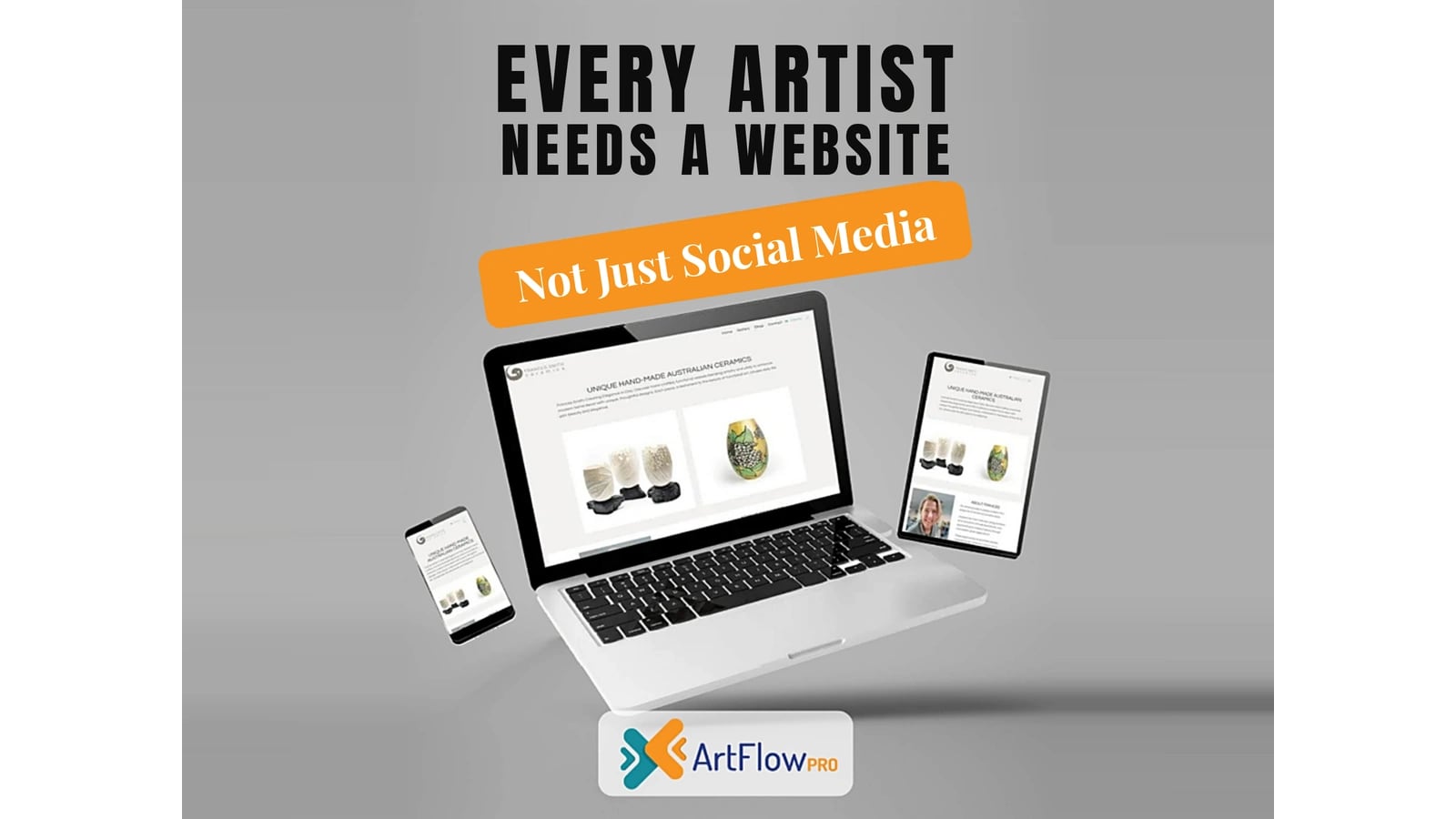
An artist website sounds like a job for later, once there's more work, more time, more money. Meanwhile, Instagram is free and already open on your phone. So why bother?
Because Instagram is a shopfront on someone else's street. They choose who walks past, they change the rules whenever they like, and if your account gets locked one Tuesday morning, years of posts and followers go with it. Your own site doesn't do any of that.
The short answer: social media is where people find you. An artist website is where they check you're serious, see everything in one place, and buy. You need both, but only one of them is actually yours.
What Instagram is good at, and where it stops
Instagram is brilliant for being found. A reel of a glaze coming out of the kiln can reach more people in a day than a gallery window does in a month. Nobody's arguing with that.
Where it falls is everything after the first look. A buyer who likes a piece has to scroll back through two years of posts to find it again. There's no proper price, no dimensions, no way to see what's still available. Galleries and prize committees don't want your handle either. They want a link.
Instagram: reach, discovery, day-to-day studio life
Artist website: the full body of work, prices, availability, your story, and a way to buy or enquire
Why every artist needs a website
It's your address, not a borrowed one
Print it on your business card, the swing tag on a vase, the sign at your stall at Salamanca Market. It'll still work in five years. An Instagram handle is only as good as Instagram's mood that year.
Buyers trust it more.
Someone about to spend a few hundred dollars on a painting wants to know you're a real person with a real practice. A tidy artist website, with a bio, a proper photo of you, and your work laid out clearly, does that job quietly.
Galleries and grant panels ask for one
Submissions, residencies, prizes and grant applications nearly always ask for a link to your work. Sending a single clean page beats sending a feed full of cat photos and exhibition selfies.
Search engines can find it.
Someone typing "handmade ceramics Kiama" or "Blue Mountains printmaker" into Google isn't going to land on your Instagram grid. They can land on your site, especially if each piece has its own page with a proper title and description.
It works while you're in the studio
A site takes enquiries at 11 pm on a Sunday while you're asleep, or covered in clay. That's the whole point.
What to put on your artist website
Keep it simple. Most good artist sites have five things:
Your work: clear photos, one page per piece, with title, size, medium, year and price (or "price on request")
Availability: sold, available, on consignment at a gallery. Buyers hate falling for something that sold last year.
About: a short bio written like you'd talk at an opening, not a CV
Where to see it in person: galleries that stock you, markets, open studio weekends
Contact: an easy way to ask about a piece, ideally one that tells you which piece they were looking at
Tip: Use the same photos and titles everywhere. If the vase is "Waratah Jar" on your site, it should be "Waratah Jar" on Instagram, at the gallery and in your Shopify store. Mismatched names are how double sales happen.
Your own domain name, the Australian way
A short web address you own is worth the small yearly fee. In Australia, a .com.au needs an Australian business connection such as an ABN, while a plain .au just needs an Australian presence. auDA runs the .au names and explains who can register what. Your name, or your studio name, is usually the best choice. Keep it easy to say out loud at a market stall.
Getting an artist website up without learning to code
This is where most artists stall. Building a site from scratch means templates, hosting, plugins, and a weekend you'd rather spend making.
ArtFlow skips most of that. Every piece you catalogue already has its photos, size, medium, and price, so your public profile is built from the same record. You get a bio, your chosen work in a grid, and a web address you can print on a card. Each artwork gets its own page with the price and a way to contact you, and portfolios let you send one link for a submission or a studio visit. It's all in the ArtFlow features.
Already selling through Shopify, WooCommerce, Squarespace, Wix, or Square? ArtFlow can publish to those from the same record, so there's one set of details behind every shop instead of four that disagree. It can also draft your Facebook and Instagram posts from the catalogued piece, so you're not retyping captions. Your socials send people to your site, and your site sells.
And nothing goes public until you say so. The directory listing is a separate tick-off, off by default.
What it costs
Less than a coffee a month, or nothing. The free tier on the pricing page is a real one, with artwork pages and portfolios included, and Pro adds unlimited artworks plus links to Instagram and Facebook. Compare that with paying a web designer and then paying again every time you want a new piece added.
Questions artists ask about websites
Do I still need an artist website if I sell well on Instagram? Yes. Instagram can change its algorithm or lock your account overnight. A website keeps your work, prices, and contact details somewhere you control, and it's what galleries and serious buyers look for.
What should an artist website include? Your work with one page per piece, prices or "price on request", what's available, a short bio, where to see the work in person, and a simple way to get in touch.
Can I sell directly from my artist website? Yes. Each piece can have a page with the price and a way to enquire, and if you already use Shopify, WooCommerce, Squarespace, Wix or Square, ArtFlow can publish your work there too.
Do I need a .com.au domain? Not necessarily. A .com.au needs an Australian business connection like an ABN. A plain .au only needs an Australian presence. Either is fine, as long as it's short and easy to say.
How long does it take to set up? If your work is already catalogued, not long. The profile is built from the pieces you've already entered, so it's mostly choosing which work to show and writing your bio.
The short version
Instagram finds you people. Your artist website turns them into buyers, gives galleries a link they can take seriously, and keeps your work somewhere nobody else can switch off. If you haven't got one yet, you're a few catalogued pieces away. Start a free account, or see how other makers present their work on the types of artwork guide and the artist directory.