
How to Write an Art Condition Report (Without Being a Conservator)
A hairline crack nobody noticed at drop-off can turn into a very awkward phone call. Here's how to write a condition report for artwork: when you need one, what to record, words to use, photos to take, and how to keep it simple.
Aima Eman · · 9 min read
A condition report sounds like something only museums bother with. Then it happens to you. A painting comes back from a three-month show with a scuff on the corner of the frame. Or a gallery rings to say one of your bowls has a chip on the rim, and you're sure it didn't have one when you dropped it off. Was it there before? Did it happen on the trip down the Hume? In the storeroom? Nobody knows, and now it's your word against theirs.
This is exactly the mess a couple of minutes of paperwork prevents. And you don't need a conservation degree, a lab coat or fancy software to do it. You need decent light, a pencil, a phone camera, and a little patience.
Key takeaways
A condition report records what an artwork looks like right now, so any change later can be spotted and traced.
Do one whenever work changes hands or moves: consignment, loans, exhibitions, freight, and sales.
Record the basics, then describe any damage, where it is and how big.
Use a small set of condition words and stick to them every time.
Photograph every side, plus close-ups of anything worth noting.
What a condition report actually is
It's a written snapshot of an artwork's physical state on a particular day, signed or initialled by whoever checked it. That's all. The University of Melbourne's guide to condition reporting puts the purpose neatly: documenting an object's current condition so changes can be tracked over time.
For artists and galleries, that one idea does a lot of heavy lifting. It settles arguments before they start. It helps with insurance claims. It tells a framer, a courier, or a new owner what they're dealing with. And it quietly shows that you take your work seriously.
When you need one
Any time an artwork changes hands or moves, it's worth doing. The usual moments:
Consignment. When you drop work at a gallery, and again when unsold work comes back.
Loans and exhibitions. Before and after a show, and on arrival and departure at each venue if it tours.
Freight. Before it's packed and as soon as it's unpacked.
Sale. When it goes to a new owner, especially for bigger or pricier pieces.
Treatment. Before and after a conservator or restorer works on it.
Museums & Galleries of NSW notes that travelling condition reports go with items on loan or tour even if a report already exists. Same idea for a painting heading to a regional prize and back. One report when it leaves your studio, a check when it arrives, another when it's packed to come home.
If you consign work regularly, our guide to consigning artwork to a gallery covers the rest of the paperwork that goes with it.
What to put in a condition report
Keep it short and consistent. Here's what most reports cover:
The basics. Artist, title, year, medium, and any inventory or catalogue number.
Measurements. Height, width and depth at the widest points. MGNSW recommends millimetres, and for framed work, measure it framed and unframed.
Description. Materials, signature, inscriptions, labels on the back, number of parts, and extras like a frame, plinth, hanging wire, or lid.
Overall condition. One word from your scale (more on that below), plus a short sentence.
Specific damage. What it is, where it is and roughly how big. "Small chip, 3 mm, on rim at 2 o'clock position" beats "minor damage".
Previous repairs. Anything already fixed, touched up, or restored.
Date and name. Who checked it, and when. Ideally both parties initial it at handover.
Where something is on the work matters. Museums use "proper left" and "proper right", meaning the artwork's own left and right, not yours as you face it. For paintings, you can just say "top left corner, viewed from the front". Pick a habit and stick to it.
Words to use (and keep using)
A good condition report is boring in the best way. Same words, same meaning, every time.
MGNSW suggests a simple scale. Excellent means as new, with little or no sign of use. Good means some wear but physically sound. Fair means minor damage that's more about looks than structure. Poor means wear, damage or loss across a big part of the work. Very poor means it's badly weakened.
For describing the damage itself, a few common terms go a long way. Abrasion is surface rubbing or scuffing. Crazing is a network of fine cracks in a glaze or varnish. Flaking is paint or glaze lifting away. Foxing is small brownish spots on paper. Cockling is the wavy rippling paper gets in humidity. If you're not sure what you're looking at, the AICCM Visual Glossary has photos of each type of damage, put together by Australian conservators. It's handy to have open on your phone.
And if you're guessing at the cause, say so. "Possibly from frame rubbing" is honest. "Caused by the courier" is a fight.
Photos: the part that saves you
Words are good. Photos are proof. The University of Melbourne guide says best practice is photographing all sides of an object, plus close-ups of any damage.
For a painting, that's the front, the back, all four edges and the corners. For ceramics, it's every side, the top, the base, and the rim. Shoot in even light, ideally the same spot every time, and pop a ruler or a coin next to any close-ups for scale. Turn on the date stamp, or at least keep the original files with their dates.
Try raking light too. Hold a torch low and almost flat to the surface, and dents, lifting paint and cracks suddenly jump out. It's a little trick conservators use, and it works brilliantly on a phone camera.
Our older post on photographing your art covers lighting and setup if you want your shots to double as portfolio images.
Tip: Write your condition report in pencil, not pen, if you're filling it in next to the artwork. One slip with a biro on a canvas or a white glaze is a much bigger problem than the one you were documenting. It's standard practice in museums for exactly that reason.
Handling while you check
A few simple habits keep the checking from causing new damage. Work on a clean, padded, stable table with plenty of room. Wash and dry your hands, or wear well-fitting nitrile gloves for surfaces that mark easily. Support ceramics with both hands and never lift by a handle or rim. Rest small round objects on foam or a rolled towel so they can't roll off.
And take your time. Rushing a condition report at the back door of a gallery, with the van double-parked on Oxford Street, is how damage gets missed. Allow a few minutes per piece. For more on day-to-day care, our guide on how to care for handmade ceramics has practical tips.
Condition reports when you ship
Freight is where most damage happens, so treat it as two checkpoints. Do a full report and photos before packing. Then ask the recipient to check it on arrival and tell you within a set time, say 48 hours, if anything has changed. That way you've got a clear before and after if you ever need to make a claim.
We covered packing, couriers and Australia Post limits in our guide on how to sell art online, so we won't repeat it here. Just add the condition check to your packing routine.
A simple condition report template
You don't need anything fancy. A one-page form with these headings works for most artists and small galleries:
Artwork details (artist, title, year, medium, ID number). Dimensions (framed and unframed, in mm). Description (materials, signature, inscriptions, parts, accessories). Overall condition (Excellent, Good, Fair, Poor, Very poor). Damage and location. Previous repairs. Photos attached (yes or no, how many). Checked by, date, and signature from each party.
Print a stack and keep them in the studio, or better, keep it all digital alongside each artwork's records so you're not hunting for paper six months later.
Keep the paperwork with the artwork
Paperwork is only useful if you can find it. Our older post on why clear delivery documentation is essential tells a few cautionary tales on that front.
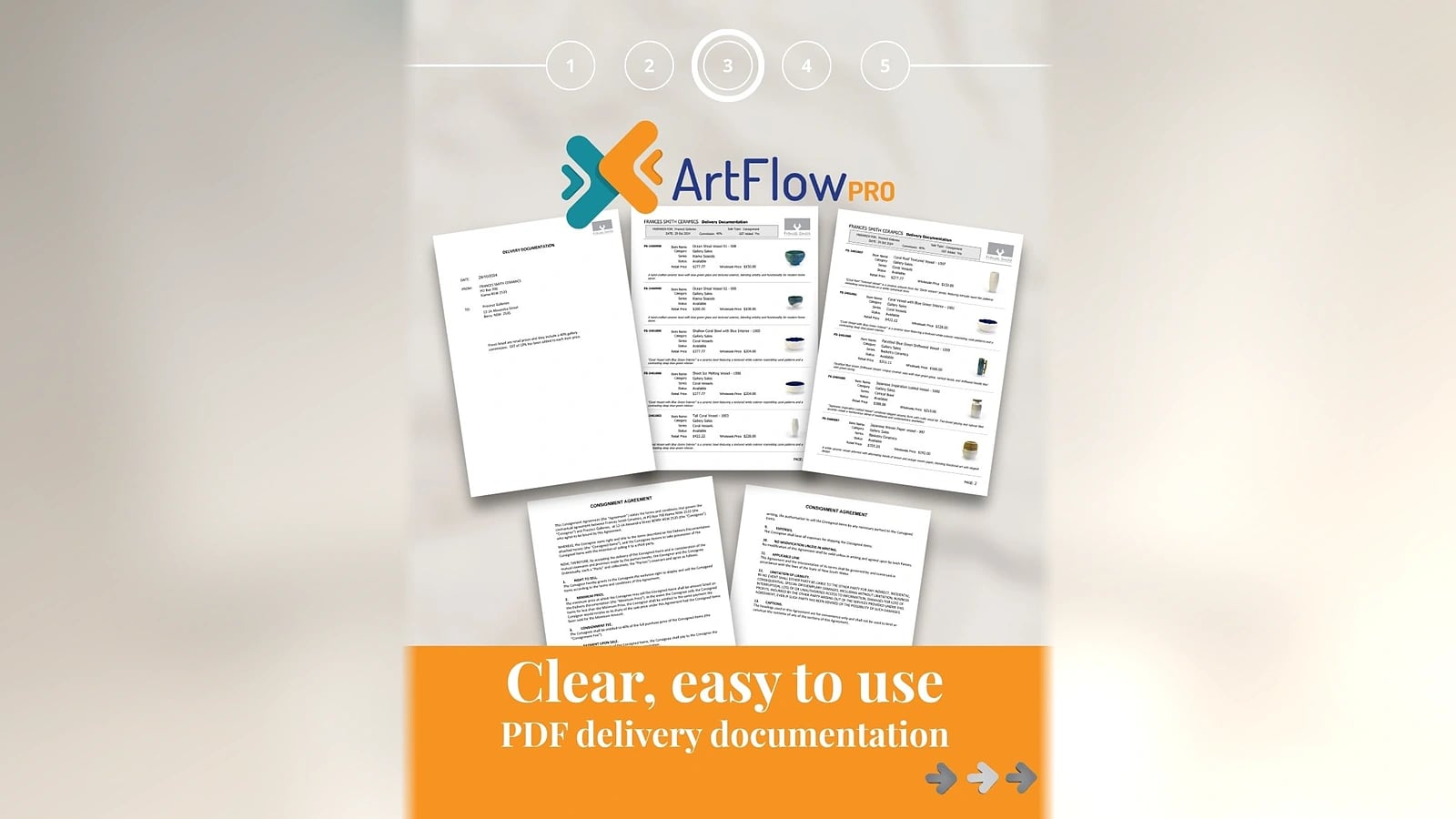
In ArtFlow, every artwork keeps its photos, details, and history in one record, and you can create delivery and consignment documents from those records as PDFs, like the ones on the cover of this post. Add your condition notes and photos to the artwork, and the next time it moves, everything's already there. The features page shows how it works.
Questions about condition reports
What is a condition report for artwork? A written record of an artwork's physical state on a specific date, usually with photos, so any later change can be spotted and traced.
When should I do a condition report? Whenever work changes hands or moves: consignment, exhibitions, loans, freight and sale. Do one before and after each move.
Who fills out the condition report? Usually the person handing over the work, with the person receiving it checking and initialling it. Galleries often have their own form.
Do I need a professional conservator? Not for everyday reports. Artists and gallery staff can record what they see. For valuable or damaged work, a conservator is worth calling.
What should I do if I find damage on arrival? Photograph it straight away, note it on the report, keep the packaging, and tell the sender or courier as soon as possible.
The short version
A condition report is a quick, honest snapshot of an artwork on a given day. Do one whenever work moves or changes hands, record the basics and any damage with clear words, photograph every side and get both parties to initial it. It takes minutes, and it can save a friendship. If you'd like your artwork records, photos, and delivery documents in one place, start a free ArtFlow account and add your condition notes as you go.