
Exhibitions
Sculpture Exhibitions in Australia: Where to Show and When to Apply
Sculpture by the Sea opens at Bondi on 16 October, and entries for it closed back in April. Here are the Australian sculpture shows worth knowing, the prize money, and when you need to apply.
Aima Eman · · 9 min read
Sculpture exhibitions in Australia mostly happen outdoors, next to water, with a southerly blowing. On 16 October, the coastal walk from Bondi to Tamarama fills up with about 100 works for Sculpture by the Sea, and half of Sydney will shuffle past with a takeaway coffee. Somewhere in that crowd there'll be a sculptor looking at a headland and thinking, how do I get my work up there?
The short answer is that you applied in April.
That's the catch with the big sculpture exhibitions. By the time everyone's talking about them, entries have been shut for six months. So treat this as a calendar as much as a guide: the big shows, a couple of smaller ones, what the money looks like, and when you need to have your application ready.
Key takeaways
Sculpture by the Sea, Bondi runs from 16 October to 2 November 2026. It's free, and there are about 100 sculptures along two kilometres of coast.
Entries for the big outdoor sculpture exhibitions close roughly six months before they open. Bondi 2026 closed in April. Cottesloe 2027 closed in August.
The top award at Bondi this year is the A$70,000 Aqualand Sculpture Award, and it's acquisitive.
Not making three-metre steel? The Woollahra Small Sculpture Prize caps works at 80 cm and pays A$25,000.
Read the terms before you enter anything. Freight, installation and insurance are often yours to sort out.
Sculpture exhibitions worth knowing, season by season
a. Spring: Sculpture by the Sea, Bondi
This is the one your relatives have heard of. Sculpture by the Sea, Bondi calls itself the world's largest free-to-the-public sculpture exhibition, and 2026 marks 30 years of it on that stretch of coast. It runs for two and a half weeks, from 16 October to 2 November.
The money is serious. The Aqualand Sculpture Award is A$70,000 and acquisitive. There are three Helen Lempriere Scholarships worth A$35,000, A$30,000 and A$25,000, two A$15,000 mentorships for emerging artists from the Clitheroe Foundation, and an A$10,000 Waverley Council Mayor's Award. You don't apply for these separately. If you're in the show, you're in the running.
There's also Sculpture Inside, an indoor exhibition of smaller pieces that runs alongside the big one. Remember that, because we'll come back to it.
b. Spring, indoors: the Woollahra Small Sculpture Prize
Not everyone has a shed, a welder and a mate with a crane truck. The Woollahra Small Sculpture Prize is for the rest of us. Nothing can be bigger than 80 cm in any direction; the main prize is A$25,000 (acquisitive), and it's been going on since 2001, so this is its 25th year. The 49 finalist works are on show at Woollahra Gallery at Redleaf in Sydney's east from 2 October to 29 November 2026. Mark Booth won this year.
If you're in Sydney for Bondi, do both in a day. They're a short drive apart, and you'll see the full range of what sculpture exhibitions can be, from tonnes of steel to something you could carry on the bus.
c. September: SWELL on the Gold Coast
SWELL Sculpture Festival wrapped up a few weeks ago at Currumbin Beach. It's been running since 2003; this was the 24th, and it had more than 100 large-scale works plus a gallery of smaller pieces. Free to walk through, partly lit up in the evenings, and the major award is A$15,000. It's a friendlier first outdoor show than Bondi for a lot of artists, and Queenslanders don't have to freight a sculpture 900 kilometres to be in it.
d. Autumn: Sculpture by the Sea, Cottesloe
Same organisers, opposite coast. Cottesloe is on from 5 to 22 March 2027 in Perth, and entries close on 20 August 2026.
e. 2027: Sculpture in the Garden, Wollongong
One for the diary. Wollongong City Council runs this every two years in the Botanic Garden at the foot of Mount Keira, and 2027 will be the sixth. The acquisitive prize is A$40,000; there's a separate A$10,000 prize for ephemeral work, and the last one pulled more than 66,000 visitors. Entries closed at the end of August 2026.
When to apply for sculpture exhibitions: the six-month rule
Look at those dates again. Bondi opens in October and closed its entries on 19 April. Cottesloe opens in March and closed in August. Wollongong is a 2027 show that closed in August 2026.
So the pattern is pretty reliable. Whatever show you've got your eye on, the form will shut about half a year before the opening, and sometimes earlier. If you want to be on the Bondi walk in spring 2027, you'll most likely be filling in an application over summer. Put a reminder in your phone today. We mean it.
Dates do shift a little each year, so check each show's own artist page and don't rely on last year's.
What an application usually asks for
Most sculpture exhibitions have their own form, but they nearly all want the same raw material:
Photos of the finished work, or drawings and a model if it isn't built yet
Dimensions and weight, and they do mean actual weight.
Materials and finish, including how it copes with weather
How it's fixed down or installed, and what the site needs
A short statement, your CV and a price
Most of that is the same information a gallery wants from you anyway. If you've already put together an artist portfolio, you're more than halfway there.
What it costs to show outdoors
This is where outdoor sculpture parts ways with every other kind of exhibiting. A painter turns up with a wrapped canvas. You turn up with 600 kilos of corten on a flatbed and a bloke called Davo operating the Hiab.
Freight is the obvious cost. Then there's installation, any engineering sign-off the organisers ask for (the public will be climbing on it, whatever the sign says), insurance, and a finish that can handle salt air for three weeks. Who pays for what differs between sculpture exhibitions, and it's all in the terms and conditions nobody reads.
Read them. NAVA's Code of Practice says organisers should clearly explain every fee, commission and cost of taking part, so if something's vague, ask. It also says something worth sticking on the studio wall: before entering an acquisitive prize, make sure the prize money covers what the work would have sold for. We made the same point about the A$40,000 Wangaratta award in our round-up of textile art in Australia.
Some shows do help. Sculpture by the Sea lists an artist cost contribution of up to A$3,000 for some Bondi exhibitors this year, and an A$20,000 subsidy for a site-specific work at the Marks Park lookout.
Tip: Make a small version. Bondi has Sculpture Inside, and SWELL has its gallery of smaller works for a reason. Someone can fall in love with your three-metre piece and still live in a one-bedroom unit in Coogee. The 30 cm version is the one that goes home with them, and it often pays for the freight on the big one.
First-time buyers nearly always start small. We wrote about how they think about starting a ceramics collection, and it applies just as well to bronze.
Pricing and paperwork for a show
Commission on sales varies from show to show, so check it before you set a price and work backwards from what you need to walk away with. For anything cast or fabricated in multiples, decide the edition size up front, number each piece, and keep a note of where every one ends up.
When the work leaves your studio, treat it the way you would a gallery delivery. List each piece, its price and its condition, take photos, and get the list signed at the other end. Our post on consigning artwork to a gallery goes through that paperwork line by line.
Keeping track of big, heavy work
Sculpture has more to remember than most mediums. Weight. Footprint. How many people it takes to lift. Which bolts. Whether it's number two or number three of the edition, and which paddock, gallery or foreshore it's currently sitting in.
ArtFlow has sculpture as one of its artwork types, so each piece can carry its own dimensions, materials, notes, photos from every side, and a running history of where it's been. When an application form asks for the weight and installation method at 11 pm on deadline night, you're copying it across, not guessing. The features page shows how the cataloguing side works.
About that Henry Moore line
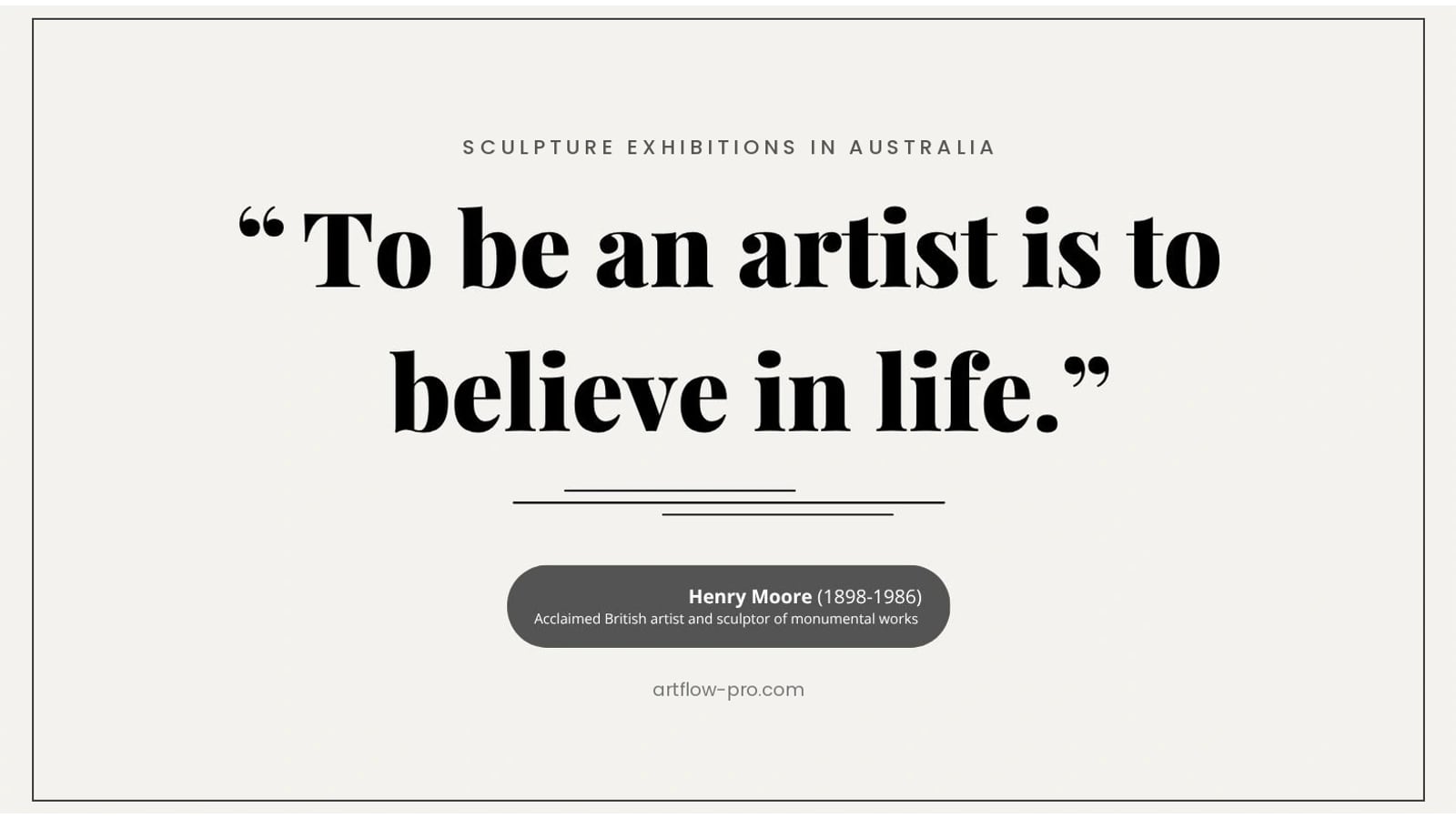
The cover of this post is a quote from Henry Moore: "To be an artist is to believe in life." He'd know. One of his big bronzes, Reclining Figure: Angles, has sat outside the Art Gallery of New South Wales since the early 1980s, in all weather.
Outdoor sculpture takes that kind of optimism. You spend months and a small fortune making something heavy, then you put it on a cliff in spring and hope. People keep doing it, and thousands of strangers keep turning up to look. That seems like a decent reason to fill in the form.
Questions sculptors ask about sculpture exhibitions.
When do entries for Sculpture by the Sea close? About six months before each show. Entries for Bondi 2026 closed on 19 April 2026, and Cottesloe 2027 closed on 20 August 2026. Expect similar timing next year and check the official artist page.
Is Sculpture by the Sea free to visit? Yes. The organisers describe it as the world's largest free-to-the-public sculpture exhibition.
How much is the top award at Sculpture by the Sea, Bondi? In 2026 it's the A$70,000 Aqualand Sculpture Award. It's acquisitive, so the winning work is bought with the prize money.
Are there sculpture exhibitions for small works? Yes. The Woollahra Small Sculpture Prize limits works to 80 cm in any dimension, and both Sculpture by the Sea and SWELL show smaller pieces alongside the outdoor ones.
Do artists pay to take part in sculpture exhibitions? Often, yes. Freight, installation and insurance arrangements differ from show to show, and some offer subsidies. It will be set out in the terms and conditions.
The short version
The best-known sculpture exhibitions in Australia run in spring and autumn, and they choose their artists about six months ahead. Pick the show that suits your scale, find its artist page, and put next year's deadline in your calendar now. Then get your records in order so the application is a copy-and-paste job. If you'd like a hand with that part, start a free ArtFlow account and catalogue your first few pieces this week.