
Art Collecting
How to Hang Art: Heights, Hooks and Rental Rules in Australia
The right height, the right hook for plasterboard or brick, picture rails, and what renters in Victoria and New South Wales are allowed to do. Everything you need to finally get that painting off the floor.
Aima Eman · · 9 min read
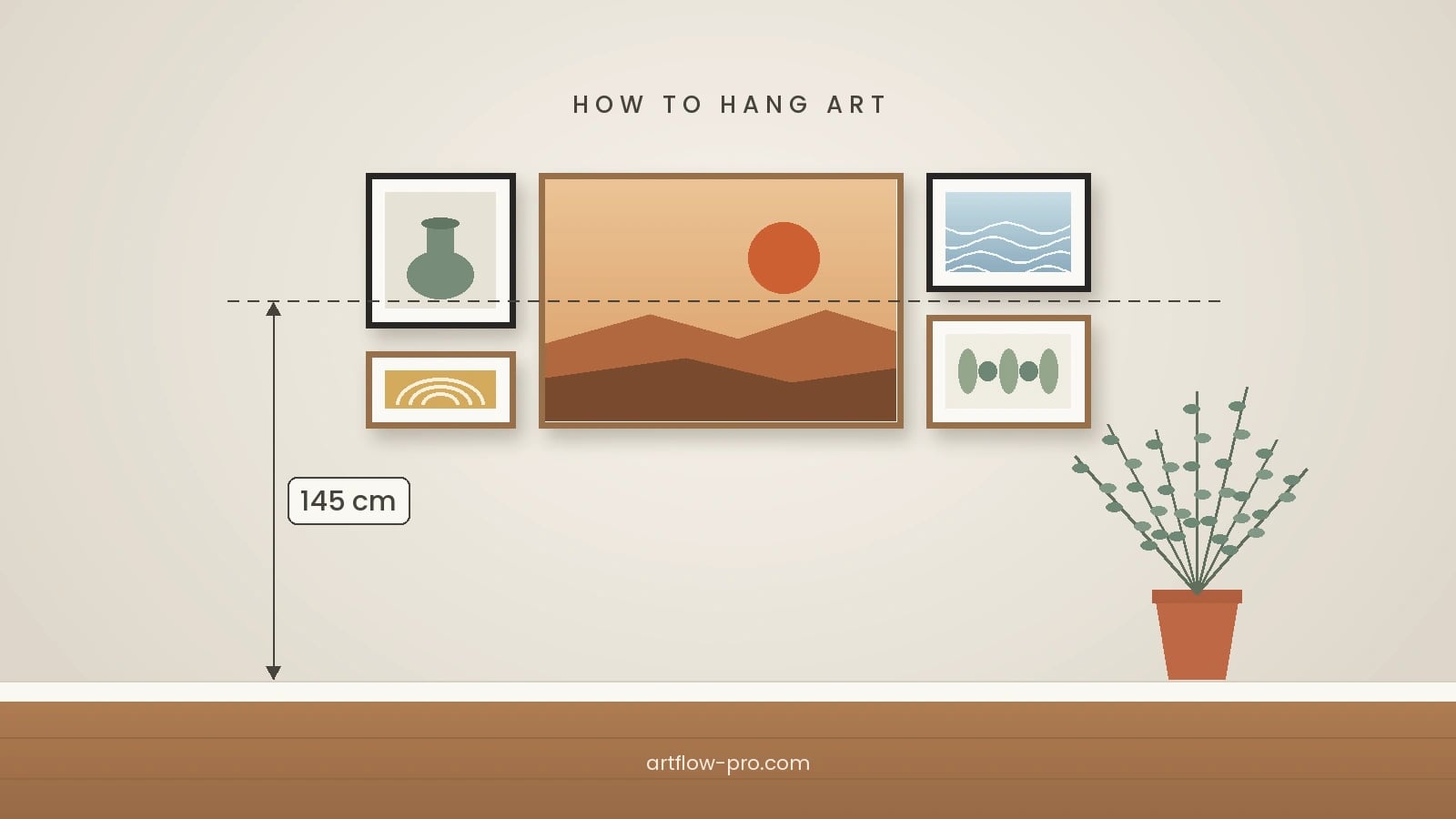
Most of us learn how to hang art the hard way. A painting comes home from the Saturday markets, gets leaned against the skirting board "just for now", and is still sitting there at Christmas, gathering dog hair. Hanging it feels risky. What if it's too high? Crooked? What if the hook rips out, or the property manager spots the hole at the final inspection?
Fair worries, all of them. They're also pretty easy to sort out once you know how to hang art properly. There's one height that suits nearly every room, a hook for every kind of wall, and (if you rent) rules that are a lot kinder than most people expect. Grab a tape measure and a pencil.
Key takeaways
Hang art so its centre sits about 145 to 155 cm from the floor. In rooms where people mostly sit, bring it down to about 120 to 135 cm.
Over a sofa, bed or sideboard, leave roughly 15 to 25 cm between the furniture and the bottom of the frame.
Find out what your wall is made of before you buy hooks. Plasterboard, brick, and old lath and plaster all need different fixings.
Renters in Victoria can put up picture hooks without asking, except on exposed brick or concrete and in heritage-registered homes. In NSW, landlords can't unreasonably refuse.
If your place was built or renovated before 1990, check for asbestos before you drill.
How to hang art at the right height
The most common mistake? Hanging it too high. Walk into plenty of shared houses, and there's a print floating up near the cornice like it's trying to leave. It happens because we see all that empty wall above the couch and feel we ought to fill it.
Picture hangers work to a simple rule of thumb when they're showing people how to hang art: the middle of the piece sits somewhere around 145 to 155 cm off the floor. That's roughly where your eyes are when you're standing. Small etching, giant canvas, doesn't matter. You measure to the centre, not the top edge.
Sitting rooms are the exception. If people mostly look at the wall from the couch or the dining table, bring it down to around 120 to 135 cm. Kitchens can go up a little, to 150 or 160 cm. And those lovely high ceilings in an old Queenslander or a Paddington terrace? Ignore them. Hang at eye level and let the wall above just be wall.
Hanging art over a sofa, bed or sideboard
Once there's furniture underneath, the furniture's the boss. Aim for a gap of 15 to 25 cm between its top and the bottom of the frame. Go wider, and the piece looks like it's drifted off on its own. Go tighter and somebody will bump it with the back of their head every time they flop onto the lounge.
Then there's width. A little print centred over a three-seater looks a bit lost, like a stamp on a big envelope. Stylists often aim for a piece (or a cluster of them) that covers around two-thirds of the furniture's width. It's a guide, not a law. If you love a small work, give it a couple of friends and hang them together.
Gallery walls without the guesswork
On Pinterest, gallery walls look effortless. In real life, they're where most of the spare holes come from.
So when you're working out how to hang art in a group, start on the floor. Lay the frames out and shuffle them around until you stop fiddling. Then trace each one onto butcher's paper (or the roll of wrapping paper left over from last Christmas), cut the shapes out and tape them to the wall with painter's tape. Mark the hook spots on the paper. Leave it up for a day or two and walk past it a few times. Paper's free to move. Plaster isn't.
Keep the gaps even, roughly 5 to 8 cm. Treat the whole cluster as one big picture, so its centre lands at that same 145 to 155 cm. And start with the biggest piece and work outwards, or you'll paint yourself into a corner.
What's behind the wall?
Australian walls are all over the shop. A brick veneer in Brisbane, a double-brick house in Perth and a Federation cottage in Marrickville will each want something different, and half of knowing how to hang art is knowing which one you've got. Knock on it and listen.
Plasterboard: hollow between the studs, solid on them. Studs are often around 450 mm apart, sometimes 600 mm. Plasterboard picture hooks (the ones with thin angled nails) are fine for light frames. For anything heavy, find a stud or use an anchor rated for the weight.
Brick or double brick: you'll see a lot of it in Perth, and in older places around Adelaide and Melbourne. Get a masonry bit and some wall plugs. A nail won't go in, and you'll only chip the render trying.
Lath and plaster: common in many Federation and Victorian homes. It cracks and crumbles around a nail, so drill a small pilot hole first or, better, use the picture rail if there is one.
Picture rails: that strip of timber moulding running around the room just under the ceiling. Hook over the rail, run cord or wire down to the frame, done. No holes at all, which renters love.
Before a drill comes anywhere near the wall, though, think about the age of the place. Australia's Asbestos Safety and Eradication Agency says a home built or renovated before 1990 probably has some asbestos in it, often in the wall sheeting of kitchens, bathrooms and laundries. Its advice is to check first, even for something as small as drilling a hole for a shelf. Not sure? Don't drill. Use the picture rail, or get it tested.
How to hang art in a rental
Renting doesn't have to mean bare walls anymore, at least not in the two biggest states.
In Victoria, Consumer Affairs Victoria puts picture hooks and screws for wall mounts, shelves and brackets on the list of things renters can do without asking. There are two catches. Exposed brick or concrete walls still need permission (though the rental provider needs a good reason to say no), and the rule doesn't cover homes on the Victorian Heritage Register. When you leave, you might have to patch the wall or pay what a fix would reasonably cost, unless your rental provider's happy to let it go.
NSW works a little differently. Under the NSW Government's renting rules, a landlord can't unreasonably refuse consent for minor changes, and hooks, nails or screws for hanging paintings and picture frames are on that list. You still have to ask, so put it in writing. Heritage homes and places on the loose-fill asbestos register are excluded, and strata buildings sometimes have rules of their own.
Somewhere else? Check with your state's tenancy authority before you start. This is general information only, not legal advice.
Tip: Snap a dated photo of the wall before anything goes up, and hang on to the hooks and a bit of filler for when you take the art down. On moving day, a tidy patch job plus a "before" photo makes the bond conversation a whole lot shorter.
Hooks, wire and D-rings in plain English
Flip the frame over. A lot of how to hang art comes down to what's on the back, and it's usually one of two things: a length of wire running across, or a D-ring screwed into each side.
Wire's the easy-going option. One hook in the middle will hold it, though it'll swing crooked every time someone slams the back door on a windy arvo. Two hooks a little apart along the wire keep it level. D-rings are sturdier and better for heavy pieces. One hook per ring, measured and levelled properly, and it isn't going anywhere.
Check the weight rating on the hook packet and go comfortably over what the piece weighs. Big frames with glass are sneaky heavy. Not sure? Stand on the bathroom scales holding it, then without it, and do the maths.
Where not to hang art
Knowing how to hang art also means knowing where it shouldn't go. Our sun is brutal. A west-facing wall that cops the afternoon light can fade a print or a textile surprisingly fast, so keep anything you care about out of direct sun. UV-protective glazing helps a lot, and our guide to fine art photography prints has the questions worth asking your framer.
Skip the spot right above the heater or fireplace too (the heat dries things out), and think twice about the bathroom, where steam gets into paper and fabric. Hanging a textile piece? That's its own little world, and we covered it in our round-up of textile art in Australia.
Light matters as much as placement. A warm lamp nearby can make a painting glow at night, and ceramic table lamps and the light they give a room are a good read if you're rethinking the whole space. Putting pottery on shelves or plate hooks instead? Read how to care for handmade ceramics before anything heavy goes up high.
Questions about how to hang art
What height should art be hung at? Roughly 145 to 155 cm to the centre of the piece. In rooms where people mostly sit, drop it to about 120 to 135 cm.
How far above a couch should art go? Somewhere between 15 and 25 cm above the back of the couch.
Can renters put up picture hooks in Australia? In Victoria, yes, and you don't need permission, except on exposed brick or concrete and in heritage-registered homes. In NSW, you need to ask, but your landlord can't unreasonably say no. Other states have their own rules.
How do I hang art on plasterboard? Plasterboard picture hooks are fine for light frames. Anything heavy should go into a stud or onto an anchor rated for the weight.
How do I hang art without drilling? Picture rails are your best friend if you've got them. Adhesive strips can hold light frames, but check the rating and test one somewhere hidden first, because they can pull paint off when they come away.
The short version
That's how to hang art without the stress. Centre it at 145 to 155 cm, leave 15 to 25 cm above furniture, keep the gaps even, and know your wall before you buy a single hook. If you rent, check your state's rules and get things in writing. Then go and get that painting off the floor. Still hunting for something to put there? Browse artworks on ArtFlow by medium and state.